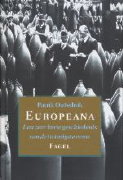
Europeana - Stručné dějiny dvacátého věku

(Europeana - A Brief History of the Twentieth Century)


About the book

Original title Europeana - Stručné dějiny dvacátého věku
First published 2001
Publisher Paseka, Prague
Pages 128
ISBN number 80-7185-404-2
Languages Czech; German; Serbian; Dutch; Hungarian; Bulgarian; French; Lithuanian; Polish; Spanish; English; Greek; Swedish; Slovenian; Italian; Russian; Croatian; Turkish; Belarusian; Hebrew; Danish; Georgian; Arabic; Japanese; Romanian; Slovak; Norwegian; Ukrainian; Latvian; Korean; Macedonian; Albanian; Portuguese; Persian; Estonian;


back to top

Rights sold to

France Allia - Paris
Hungary Kalligram - Budapest
The Netherlands Fagel Publisher - Amsterdam
Austria Czernin Verlag - Vienna
Poland Fundacja Pogranicze - Sejny
Serbia B92 Publishers - Belgrade
United States Dalkey Press - Chicago
Bulgaria Faakel - Sofia
Lithuania Apostrofa - Vilnius
Spain Ediciones Tempora - Salamanqua
Greece Kedros - Athens
Sweden Natur och kultur - Stockholm
Italy Duepunti Edizione - Palermo
Israel Xargol - Tel Aviv
Slovenia Borec - Ljubljana
Croatia Profil International Publishing - Zagreb
Denmark Gyldendal - Kopenhagen
Turkey Dost Kitabevi Yayinlari - Ankara
Russia Limbakh - St. Petersburg
Georgia Pegasus - Tibilisi
Egypt Al Arabi - Cairo
Japan Hakusui-sha - Tokyo
Romania Vremea - Bucharest
Norway Bokvennen - Oslo
Slovakia Premedia - Bratislava
The Netherlands Uitgeverij IJzer - Utrecht (new edition)
Korea The Open Books Co - Paju Book City
Ukraine Stareho Leva - Lviv
Latvia Petergailis - Riga
Belarus Lohvinau Literature House - Vilnius
Macedonia Templum - Skopje
Italy Quodlibet - Macerata (new edition)
Albania Ombra gvg - Tirana
Estonia Loomingu Raamatukogu - Talinn
Sweden Aspekt - Stockholm (new edition)
Portugal Antigona - Lisboa
Taiwain Domain Publishing - Taipei City
Finland Siltala Publishers - Helsinki
Philippines Czech emnbassy - Manila
Armeninia Vogi-Nairi - Yerevan
Stage rights
Belgium (Dutch) 2009 and 2016, Theater Zuidpool - Antverp
Hungary 2016, Népszinház Subotica- Subotice
United Kingdom 2017, Artangel - London
Greece 2017, Railway Carriage Theater - Athens
Belgium (Dutch) 2018, School of Arts - Ghent
Belgium (Dutch) 2018, TarTar - Ostend
United Kingdom 2019, Royal Shakespeare Company - Stratford-upon-Avon
Germany 2020, Schauspiel Stuttgart - Stuttgart
Italy 2020, Associazione Culturale Sotterraneo - Florence
Italy 2020, Associazione Mittelfest - Cividale del Friuli
Motion picure rights
Germany 2021, Corso Film - Cologne


back to top

Synopsis

Patrik Ouředník's novel is a unique version of the history of the twentieth century. Told in an informal, mesmerizing voice, Ouředník represents the twentieth century in all its contradictions and grand illusions, demonstrating that nothing substantial has changed between 1900 and 1999 - humanity is still hopeful for the future and still mired in age-old conflicts. As he demonstrates that nothing can be reduced to a single, "true" viewpoint Ouředník mixes hard facts and idiosyncratic observations, highlighting the horror and absurdity of the twentieth century and the further absurdity of attempting to narrate this history.

back to top

What the press says

Chronic'art, Bernard Quiriny
Ouředník's idea is brilliant: in order to draw the map of this century and decide on the most important events, he simply presents in a jumble hundreds of historical facts ranging from trifling anecdotes to crucial statistics... Europeana reads like a frenzied encyclopaedic compression of thousands of history books; it's cleverly constructed and more subjective than it first appears... Laughs guaranteed, uneasiness probable, impressions strong: in short a great book.

Radio France
Heir of Kafka and of the good soldier Svejk, Ouředník takes advantage of the interval between facts of an irrefutable precision to create summaries as disconcerting as they are pre-emptory.

Le Temps,19/06/2004, Isabelle Rüf
Enthralled by matters of language, Ouředník offers a burlesque vision of the history of contemporary Europe, combining the tragic aspect of the situation with anecdotal facts that stress the absurdity of the twentieth century.

back to top

Excerpt

Europeana - A Brief History of the Twentieth Century

Translated from the Czech by Gerald Turner
© English translation Gerald Turner

The Americans who fell in Normandy in 1944 were tall fellows measuring 173 cm. on average, and if they were laid head to foot they would measure 38 kilometres in total. The Germans were tall fellows too, while tallest of all were the Senegalese fusiliers in World War I who measured 176 cm. so they were sent into battle in the first ranks in order to scare the Germans. It was said of the First World War that people in it fell like seeds and the Russian Communists later calculated how much fertiliser a square kilometre of corpses would yield and how much they would save on expensive foreign fertilisers if they used the corpses of traitors and criminals for manure. And the English invented the tank and the Germans invented gas, which was known as yperite because the Germans first used it near the town of Ypres, although apparently that was not true, and it was also called mustard gas because it stung the nose like Dijon mustard, which was apparently true, and some soldiers who returned home after the war were never able to eat Dijon mustard again. The First World War was known as an imperialist war because the Germans felt that other countries were prejudiced against them and did not want to let them become a world power and fulfil some historical mission. And most people in Europe, Germany, Austria, France, Serbia or Bulgaria, believed it to be a necessary and just war which would establish peace in the world. And many people believed that the war would revive those virtues that the modern industrial world had forced into the background, such as love of one's country, courage and self-sacrifice. And poor people looked forward to riding in a train and country folk looked forward to seeing big cities and phoning the district post-office to dictate a telegram to their wives, AM WELL, HOPE YOU ARE WELL TOO. The generals looked forward to being in the newspapers and people from national minorities were pleased that they would be sharing the war with those who spoke without an accent and that they would be singing marching songs and jolly popular ditties with them. And everyone thought they'd be home for the grape harvest or by Christmas at the latest.
      Some historians subsequently said that the twentieth century actually started in 1914, when war broke out, because it was the first war in history in which so many countries took part, in which so many people died and in which airships and aeroplanes flew and bombarded the rear and towns and civilians, and submarines sunk ships and artillery could lob shells ten or twelve kilometres. And the Germans invented gas and the English invented tanks and scientists discovered isotopes and the general theory of relativity, according to which nothing was metaphysical, but relative. And when the Senegalese fusiliers first saw an aeroplane they thought it was a tame bird and one of the Senegalese soldiers cut a lump of flesh from a dead horse and threw it as far as he could in order to lure it away. And the soldiers wore green and camouflage uniforms because they did not want the enemy to see them, which was modern at the time because in previous wars soldiers had worn highly coloured uniforms in order to be visible from afar. And airships and aeroplanes flew through the sky and the horses were so terribly frightened. And writers and poets endeavoured to find ways of expressing it best and in 1916 they invented Dadaism because everything seemed crazy to them

back to top